
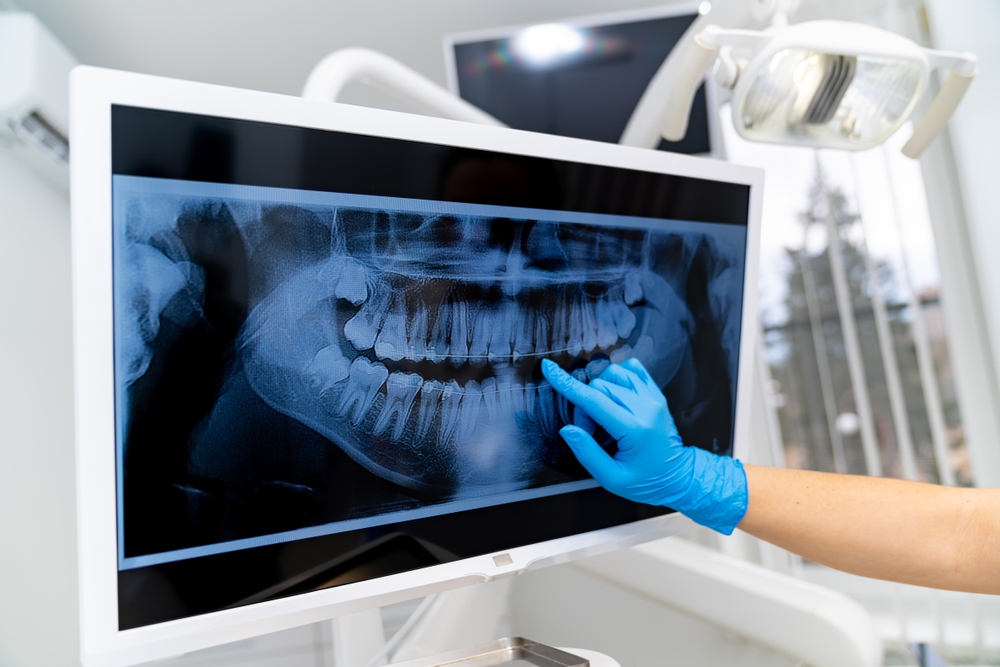
Anyone who’s ever sat in a dental chair and watched the assistant drape a heavy apron over their chest has probably wondered the same thing. Is this radiation actually doing any harm? It’s a fair question, and one that a good dentist in Darwin hears regularly. The short answer is that dental X-rays are among the lowest-radiation imaging procedures in modern medicine, and the diagnostic benefits far outweigh the tiny risk. Whether it’s a routine check-up, ongoing family dentistry, or planning for wisdom tooth removal, X-rays give dentists information they simply can’t get any other way.
How Much Radiation Are We Actually Talking About?
Radiation gets measured in units called microsieverts. A single digital dental X-ray delivers roughly 5 microsieverts. To put that in perspective, the Australian Radiation Protection and Nuclear Safety Agency (ARPANSA) reports that Australians receive about 1,500 to 2,000 microsieverts every year from natural background sources alone. That’s cosmic radiation, radon in the air, and radioactive elements naturally present in soil and food.
So, one dental X-ray equals roughly a day or two of simply existing on Earth. A return flight from Darwin to London exposes passengers to around 80 microsieverts, which is the equivalent of about 16 dental X-rays. Eating a banana delivers a measurable dose too, thanks to naturally occurring potassium-40.
A full-mouth series of X-rays, which most people won’t need often, comes in around 30 to 80 microsieverts depending on the equipment. A chest CT scan, by comparison, sits near 7,000 microsieverts.
Digital Technology has Changed the Numbers
The old film-based X-ray systems needed considerably more radiation to produce a usable image. Digital sensors have cut exposure by 50 to 80%, according to research published by the American Dental Association. Most Australian practices switched to digital years ago.
Modern machines also use rectangular collimation, which narrows the beam so it only covers the area being imaged rather than spraying wider than necessary. Faster image capture means shorter exposure times. Lead aprons and thyroid collars add another layer of protection, particularly for the thyroid gland, which shows more sensitivity to radiation than most tissues.
Why do Dentists Take X-Rays?
Decay between teeth stays invisible to the naked eye until it’s already caused significant damage. Bone loss from gum disease can’t be measured by looking. Abscesses, cysts, and tumours in the jaw develop silently. Impacted teeth sit hidden beneath the gum line.
X-rays catch these problems early, when treatment stays simple and affordable. A small cavity spotted on a radiograph needs a filling. The same cavity found two years later might need root canal treatment or extraction.
For wisdom tooth removal, imaging matters even more. Panoramic X-rays show the position of each wisdom tooth, its root shape, and how close it sits to the inferior alveolar nerve. Without that picture, surgery carries far greater risk of nerve damage. Sometimes a cone beam CT scan provides three-dimensional detail for complex cases.
How Often Should Someone Have Them?
There’s no universal schedule, and that’s deliberate. The Australian Dental Association supports individualised assessment rather than automatic annual X-rays.
Patients with healthy teeth, good oral hygiene, and no history of decay might go two to three years between bitewing X-rays from a dentist in Darwin. Those with active decay, previous restorations, or gum disease may need them every six to twelve months. Children often need slightly more frequent monitoring because their teeth develop rapidly and decay progresses faster through thinner enamel.
Anyone unsure about frequency should simply ask why a particular X-ray is being recommended. Good practitioners explain their reasoning happily.
Pregnancy and Children
Pregnant patients can safely have dental X-rays when clinically necessary. The radiation dose to the abdomen from a dental X-ray registers as essentially zero, and lead aprons eliminate scatter. That said, most dentists postpone routine imaging until after delivery and only proceed when there’s an urgent diagnostic need.
Children receive lower doses still, since equipment settings adjust for smaller anatomy. Practices offering family dentistry typically follow strict paediatric protocols, using the smallest sensors and shortest exposure times appropriate for each child.
Dental X-Rays are Safe at your Family Dentistry Clinic in Darwin
Dental X-rays carry an extremely small radiation risk, comfortably outweighed by what they reveal. Skipping necessary imaging poses a far bigger threat to long-term oral health than the radiation itself. A trusted dentist in Darwin will recommend X-rays based on individual need, not a fixed timetable, whether the visit involves routine family dentistry or planning wisdom tooth removal. Patients who understand the numbers usually feel a lot more relaxed in the chair.